Music
It was the Boston Symphony with which he made his way, and Tanglewood where that part of his life began.
LENOX, Mass. — Michael Tilson Thomas had just brought the first movement of Copland’s Symphony No. 3 to a radiant close here at Tanglewood on Saturday night when applause broke out at the back of the Shed.
And why not? Copland’s score is one of the works most associated with the Boston Symphony, and he wrote parts of it on these very grounds. It was music, Thomas has suggested, “that the world would come to accept as the sound of America.”
The applause went on, until it sounded like just a single admirer was left clapping, insistently. Thomas turned, smiled, and joked, “I agree.”
He always has agreed, and this great American maverick will to the end. The conductor, 77, underwent surgery last year to treat glioblastoma, a lethally aggressive brain cancer, and in March he announced that he was permanently reducing his activities. “I intend to stick around for a bit,” he said then; despite the odds, he has.
So Thomas could have been forgiven reflectiveness, if not more, leading the Boston Symphony Orchestra in concerts Saturday and Sunday, Copland in one and Ives in the other. After all, for all his might and ideas as the music director of the San Francisco Symphony, a tenure that lasted from 1995 to 2020 and defines his career, it was the Boston Symphony with which he made his way, and Tanglewood where that part of his life began.
Thomas emerged as a Tanglewood fellow, arriving here for the first time in 1968 and winning the Koussevitzky Prize for an outstanding student conductor a year later. He was named the Boston Symphony’s assistant, associate, and principal guest conductor in turn — the latter a title he shared with Colin Davis — and until his departure in 1974, he drew note for programs that put the new in the context of the old, as well as for recordings that still sound fresh, lush and keen, including a glorious Piston Second and a pungent “Rite of Spring.” Four instrumentalists who played with Thomas then — bassists Lawrence Wolfe and Joseph Hearne, violinist Ikuko Mizuno and violist Michael Zaretsky — played with him last weekend, too.
But in a recent interview with The New York Times, Thomas said that he felt “calm and resigned” about his circumstances, and though the Tanglewood grounds seemed to flower for him with a special resplendence, there was little sense of a farewell to these performances, little sense of there being some grand valedictory message, even if there were those in the audience who stood to welcome him before he had conducted a note.
There was just Michael Tilson Thomas, doing Michael Tilson Thomas things.
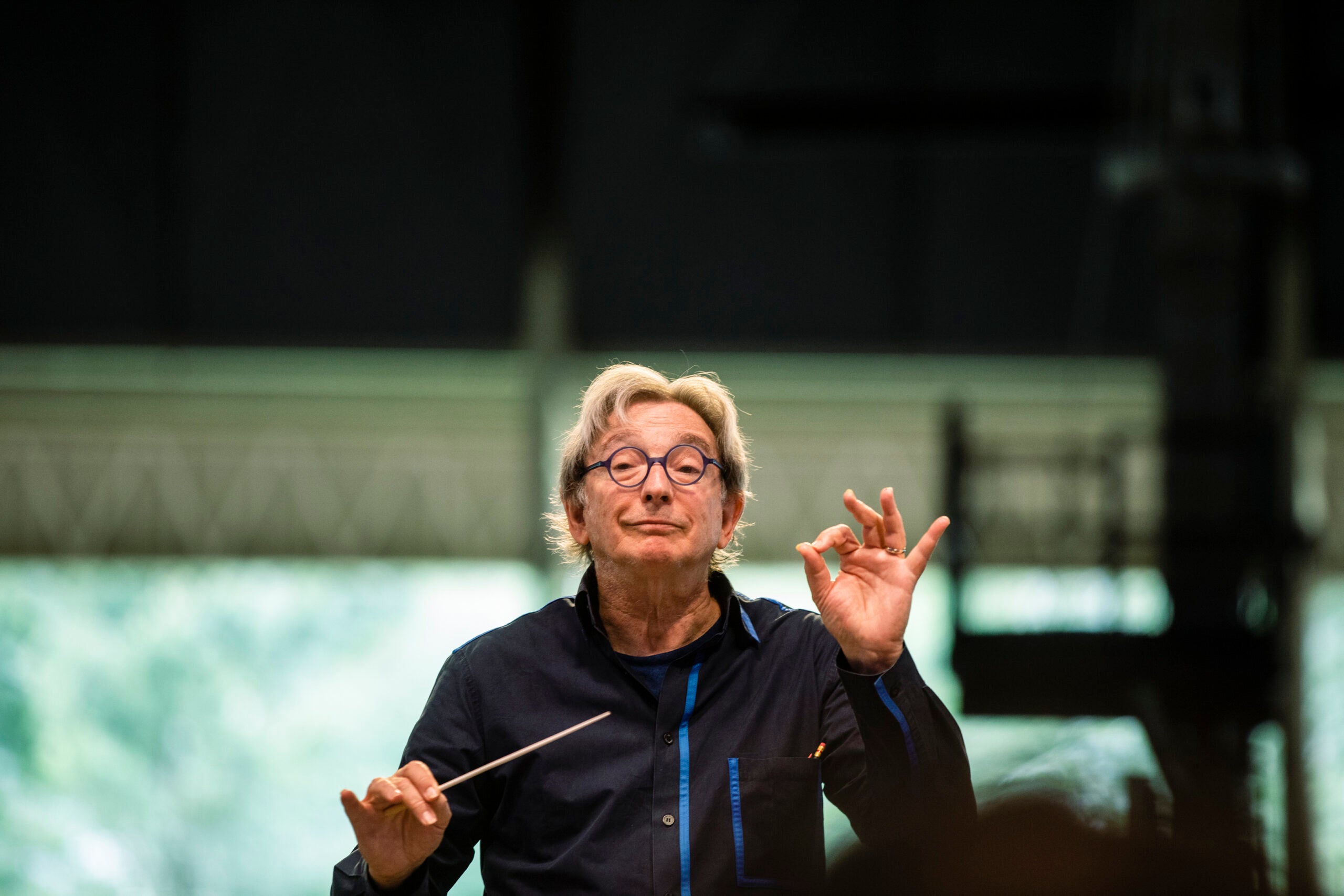
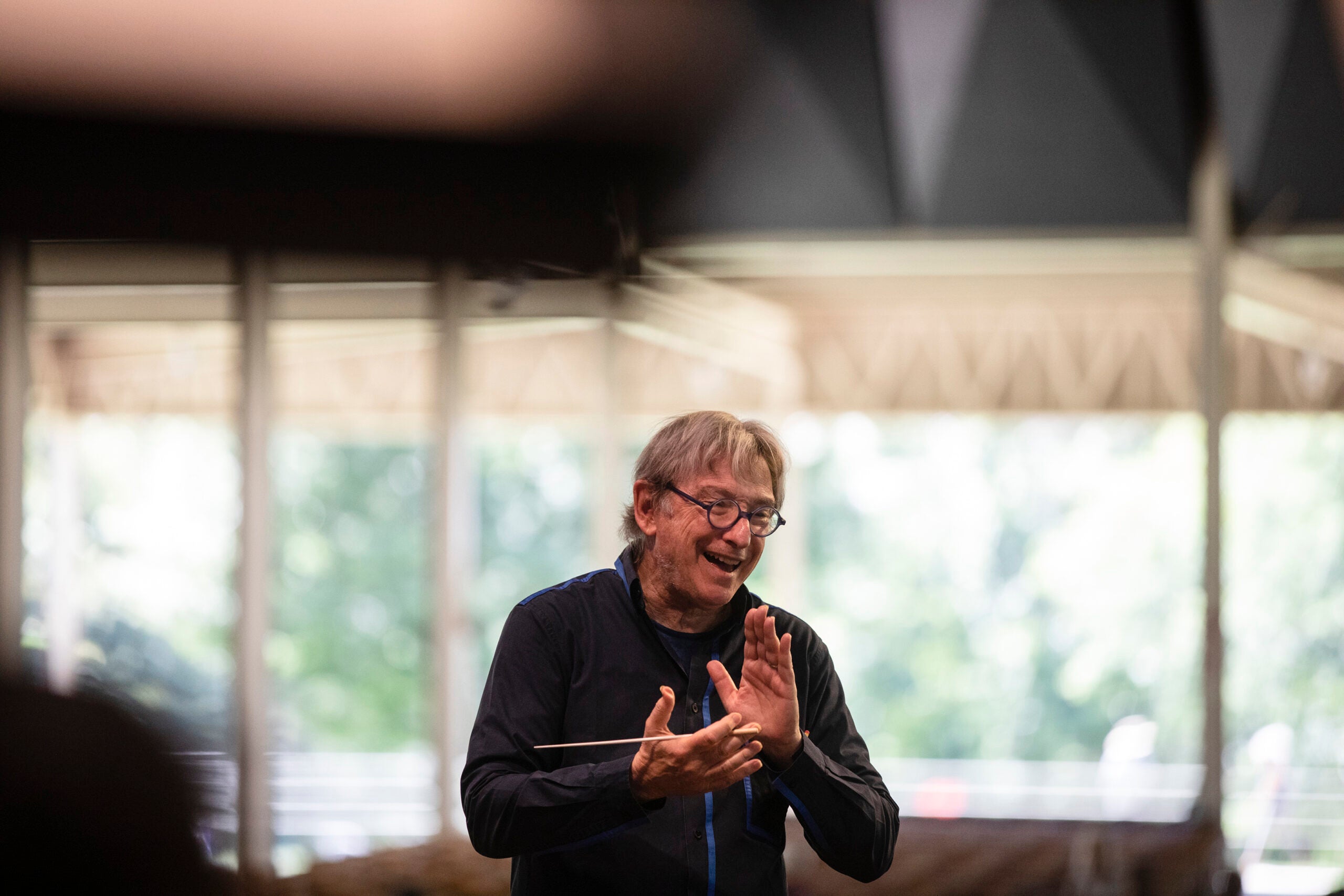
And what things. Thomas is understandably not so excitable on the podium now, but he is anything but disengaged, and, standing throughout the concerts, his old theatricality still takes the odd bow. His right hand dominates, keeping a steady if revealing beat, and his interest in carefully shaping details is still there, as is his accuracy of gesture. Clarity appears to be his aim, and he spent a lot of his time dealing with balances in each of the four works he conducted: holding a hand up here, twinkling his fingers there, sprinkling experience into the routine.
Since his days exploring the avant-garde as the conductor of the Monday Evening Concerts in the 1960s, Thomas has considered the concert hall to be a place of inquiry and thought, of connections and contrasts, and the Shed was no different on these occasions. He still has things to say.
Saturday’s concert could have been political if Thomas had wanted it to be, but he voiced nothing explicit. The program put Copland’s symphony, which was given with typically heartfelt commitment, in conversation with “Dubinushka,” a jaunty though trite little tribute that Rimsky-Korsakov based on a workers’ song and offered to the Russian revolutionaries of 1905, and Rachmaninoff’s Piano Concerto No. 3, which the composer wrote specifically for U.S. audiences before a tour in 1909.
Alexander Malofeev, 20, was the soloist, which made the performance delayed compensation for a collaboration between him and Thomas that had been canceled in March, when the Montreal Symphony Orchestra declared that it would be “inappropriate” for the Moscow-born pianist to perform. Entirely innocent to begin with, Malofeev had condemned the Russian invasion of Ukraine days earlier, calling it a “terrible and bloody decision” after another concert in Canada had been ccalled off far in advance. Thomas, a devoted supporter of up-and-coming musicians in his founding of the New World Symphony and in other work, was clearly pleased that they could perform together here, beaming during the ovations.
You could hear why: Malofeev is already a special pianist. Plenty of young artists use the Rachmaninoff to show off sparkling technical skills, and Malofeev had those in abundance. But he was interested in something more than that. The first movement was broad, dreamy, nightmarish, the left hand disrupting melodic lines; the cadenza was unsettlingly introspective. The second movement became a balm, the third a triumph, and if that finale was dangerously soaked in schmaltz, well, that’s Rachmaninoff for you. Thomas, to his credit, went where Malofeev took him, and brought the orchestra along, too.
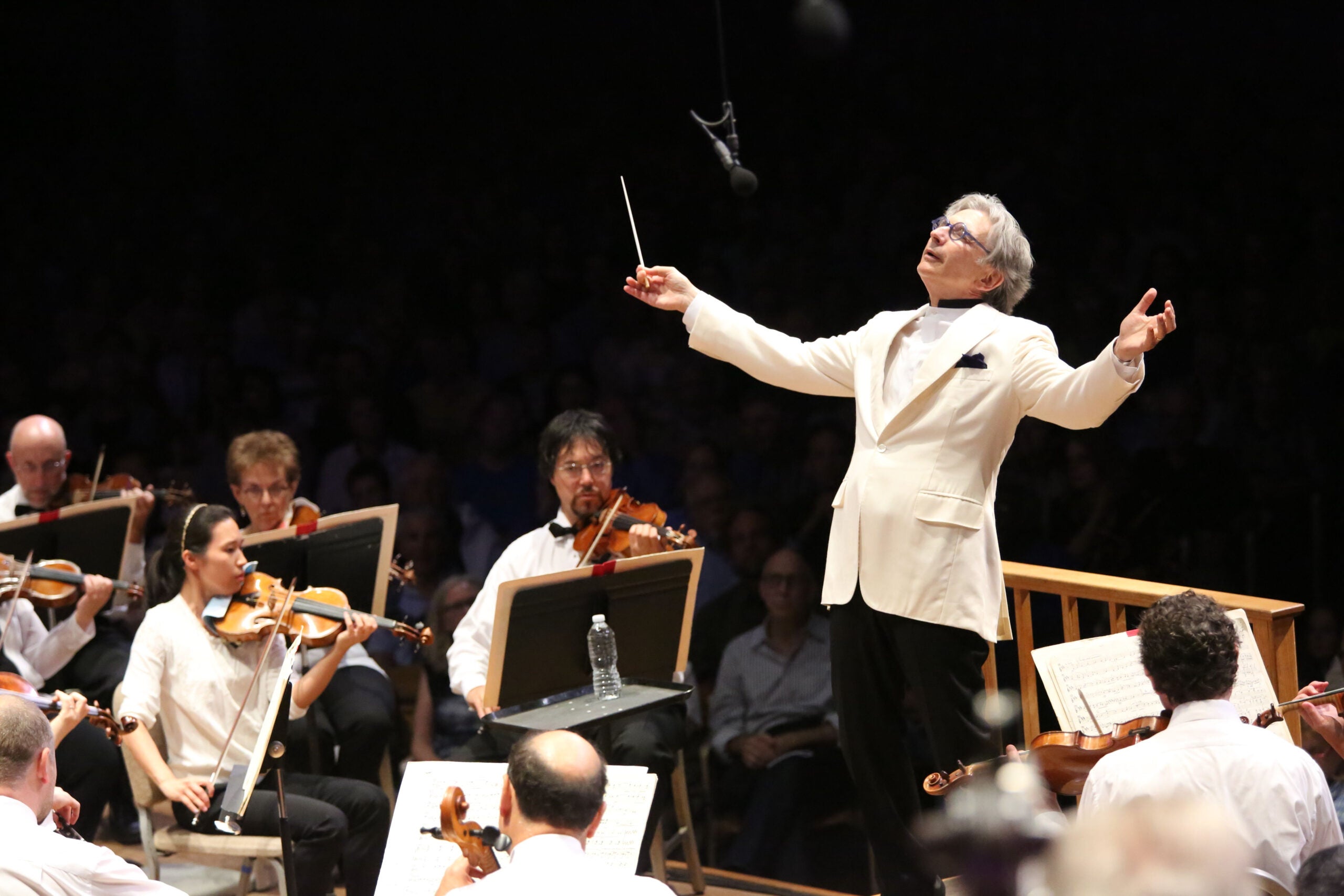
Sunday’s concert offered an opportunity for Thomas to make more of an interpretive statement with the season-ending performance of Beethoven’s Ninth Symphony, a Tanglewood tradition. He did, in a sense, sticking to the way his Beethoven has been of late, steadier and heftier than the new norm.
With the Tanglewood Festival Chorus on hand, along with a vocal quartet of Jacquelyn Stucker, Kelley O’Connor, Ben Bliss and Dashon Burton, this was stoic Beethoven, calm, confident and controlled, lyrical in the slow movement but tender rather than rapt — Beethoven of the here and now, in other words, and not of the beyond. Some hard-thwacked timpani aside, it was also firmly of the old school. With its forward woodwinds and its resolute strength of line — the fugue in the finale was downright stubborn — it almost reminded me of Otto Klemperer.
Charles Ives’ “Psalm 90,” an ethereal yet cosmically dissonant prayer for soprano, tenor, chorus and organ, prefaced the Beethoven in a characteristically ear-dislocating bit of Thomas programming, though he left the choir director, James Burton, to conduct. Ives worked on it for years, and he eventually came to think of it as his farewell to composition; its ending is profoundly comforting.
“So teach us to number our days,” its text reads in part, “that we may apply our hearts unto wisdom.”
Perhaps there was a message, after all.
This article originally appeared in The New York Times.
Stay up-to-date on the Music Club
Catch up on the latest discussions and performances from local musicians in your inbox.